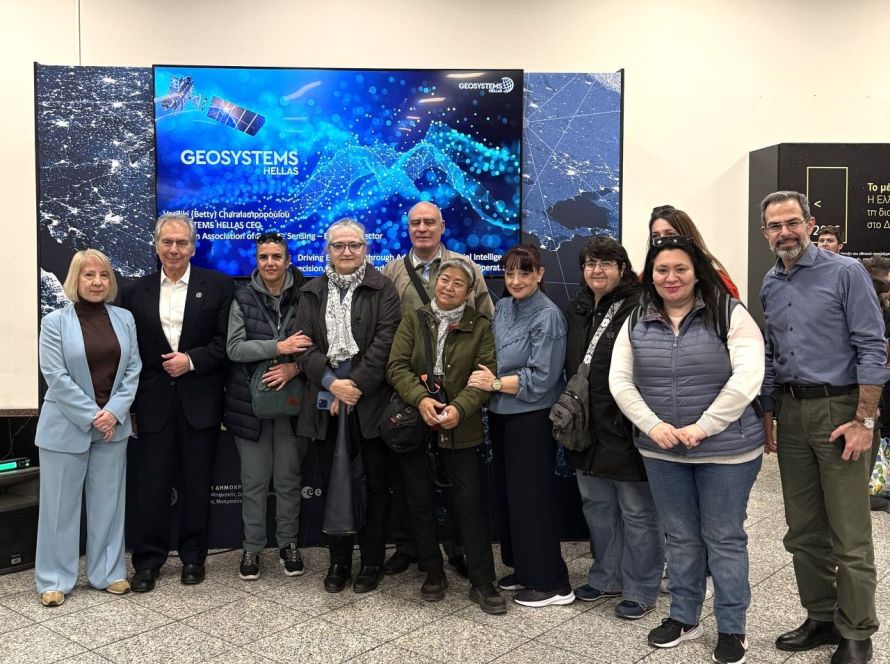
A working meeting for the “Land & Forest” services of Axis 3 of the Greek Microsatellites project was held at the Foundation for Research and Technology – Hellas (FORTH) on 8–9 April.
The meeting focused on the use of Earth Observation, satellite data and geospatial services for environmental monitoring and public sector decision-making.
Focus on Earth Observation for Crete
The meeting was organized by Nektarios Chrysoulakis, Head of the Remote Sensing and Applications Laboratory in Urban and Natural Environments at FORTH. He is also the coordinator of the urban environment services of the Land project.
Representatives from the Region of Crete highlighted the importance of satellite data for monitoring key environmental and societal challenges, including:
- land use changes
- earthquake-related micro-movements
- desertification
- Natura areas
- forests
- air quality
- public health
- quality of life
Greece’s National Microsatellite Program
Through the National Microsatellite Program, Greece is expected to acquire 11 Earth Observation microsatellites within 2026.
These microsatellites will be supported by geospatial services that aim to strengthen:
- environmental protection
- climate change adaptation
- natural resource management
- crisis response
GEOSYSTEMS HELLAS Role
In this framework, the Region of Crete collaborates with FORTH and GEOSYSTEMS HELLAS S.A.
GEOSYSTEMS HELLAS participates as Coordinator of the Land project and Sub-coordinator of the Forest project. The company contributes its expertise in Earth Observation, geospatial technologies, and satellite data services.
Strong Scientific and Industrial Participation
The meeting was also attended by representatives of the European Space Agency (ESA), the National Observatory of Athens, the Aristotle University of Thessaloniki, the University of Patras, the National Technical University of Athens, and participating companies, including NERCO and Wings ICT.
Source: Region of Crete